Three Lenses, a Wider View: Gaining Insight
When you think about going global, what comes to mind?
Chapter 1three lenses Expand your view to gain insights
When you think about going global, what comes to mind?
In recent years, the dual impact of the U.S.-China trade war and the COVID-19 pandemic has driven major shifts in global supply chains.
Companies once based in China, the world's manufacturing hub, are restructuring their supply chains and accelerating global expansion amid internal and external pressures to seize new market opportunities.
This migration trend is not limited to Chinese companies. Many firms that previously invested in mainland China—including Taiwanese enterprises—are now turning their attention to emerging markets in Southeast Asia to diversify supply chains, reduce risks, and better adapt to global market shifts.
At the same time, facing geopolitical risks and economic uncertainty, more people are turning to international asset allocation to preserve and grow their wealth. Immigration and education have also become key concerns for affluent individuals and the middle class, who seek better living conditions and educational opportunities through immigration or asset transfers.
They all stepped out of the familiar environment of the past 20 years to seek new opportunities in overseas markets, giving rise to the "going global" wave discussed in this book.
We can see that the reasons and motivations for going global are complex and diverse, involving corporate strategy, individual choices, national policies, international developments, and geopolitical factors. The landscape is filled with a wide array of news, ideas, theories, and strategies—often intricate and even contradictory.
In this era of rapid change and information overload, how can we quickly and effectively organize information? How to identify risks and opportunities brought by the shifting landscape? And how to extract unique insights from it? These have become urgent needs for businesses and individuals developing in the region.
MIT three-lens methodology: Observe from different angles
This reminds us of MIT's "Three Lenses Analysis."
This methodology first appeared in the 20th century, in the 1990s book "Managing for the Future," which guides leaders to navigate organizational change by addressing strategy, politics, and culture to simplify complexity.
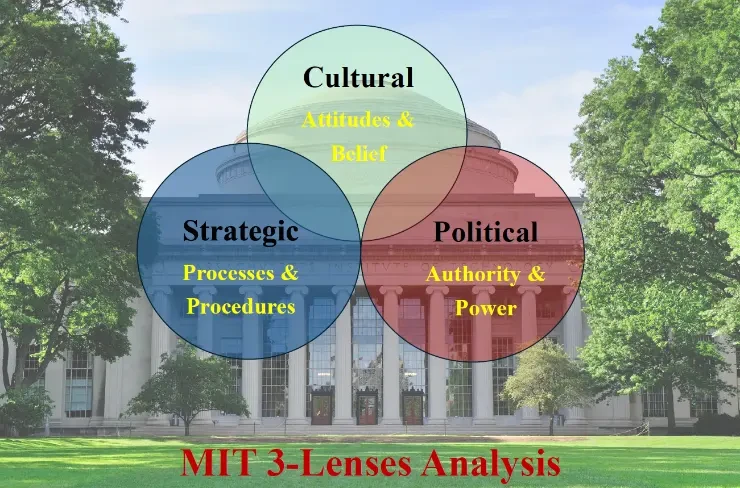
The strategic perspective described by MIT views the organization as a structure designed to achieve specific goals, focusing on formal structures, role assignments, and information flow.
From a political perspective, organizations are viewed as arenas for power and resources, emphasizing conflict, negotiation, and alliances.
From a cultural perspective, the focus is on organizational values, norms, and cultural context.
The advantage of this methodology lies in its comprehensive analytical framework, enabling leaders to better understand organizational challenges and opportunities, make more effective decisions, and enhance management performance.
The effectiveness of MIT's Triple Lens methodology in practice is undeniable, yet its original framework does not emphasize the logical relationships among the three perspectives or the critical factor of time.
To make this observation method applicable to more scenarios,Mr. Paul S.P. Hsu Proposed optimization recommendations advocating analysis from three interrelated perspectives: Economic Transformation, Social Transformation, and Political Transformation.
In short, as economic development lifts people out of poverty and into prosperity, the demand for dignity and social recognition rises. This shift drives changes in interpersonal relationships; once accumulated to a critical point, it triggers large-scale political transformation. Thus, these factors are not only causally linked but also unfold over time with continuity, offering a more complete perspective on economic and social change.
We adopted MIT's analytical framework, incorporated expert feedback, and shifted our perspective to three key dimensions: History, Geopolitics, and Technology. This is the essence of the book's title:The Chinese Diaspora. We'll explain why we use this later. three lenses? And how to utilize this three lenses Tame vast, conflicting information and turn it into your own insights?
Bias is inevitable; wear more. several kinds of lenses
"Mr. Law" has invited me to speak at MIT, Harvard University, the University of Hong Kong, and in Vietnam and Malaysia. I used this methodology to engage with audiences, receiving enthusiastic feedback. As "Mr. Law" succinctly noted: Everyone has biases because our perspectives are inevitably shaped by environment, knowledge, and experience. However, by consciously considering multiple viewpoints, we can see things we previously could not.
This aligns with Edward de Bono's "Six Thinking Hats," an effective tool for resolving cognitive confusion and conflicting opinions. Each of the six colored hats represents a distinct thinking role, allowing decision-makers to rotate through them for structured discussion: White Hat focuses on facts; Red Hat expresses intuition; Black Hat assesses risks; Yellow Hat identifies benefits; Green Hat stimulates creativity; Blue Hat manages and integrates the process.
The "Six Thinking Hats" method emphasizes using one thinking mode at a time to focus on a single issue, avoid confusion, and analyze problems comprehensively from multiple perspectives. By switching roles, it enables suggestions from different standpoints and generates deeper insights.
This is crucial because it allows you to calm down, step back from your original perspective, and see things you otherwise would miss. This creates opportunities for new insights, helps identify blind spots in your thinking, and enables you to navigate the challenges of going global with wisdom.
By selecting the perspectives of "History," "Geopolitics," and "Technology"—the very title of this book.The Chinese Diaspora, Focus separately on the following cross-border issues:
Approved the lenses of history, We examine the hidden motivations behind our positioning and business decisions.
Approved the lenses of geopolitics, We understand the underlying logic of great power competition and guide your global expansion.
Approved the lenses of technology, We anticipate future trends to gain a competitive edge.
And careful readers will also notice that "History," "Geopolitics," and "Technology" are... three lenses, It also represents the past, present, and future, signifying temporal continuity.
Our goal is to leverage MIT's methodological framework to rapidly and effectively gain comprehensive insights amid global upheaval and information overload, enabling us to master the risks and opportunities these changes bring.
This book explores this methodology, focusing on Vietnam and Malaysia in Southeast Asia as recent hotspots for international expansion. However, the approach is applicable to global markets. Whether you're analyzing customer suitability for South America, the Middle East, or Europe, you can use the same framework to identify gaps and gain insights through systematic analysis.
- Book
- The Chinese Diaspora
- Author
- Dr. Jili Chung
- Section
- Subject
- Words
- Appointment2,057Character
- Reading
- Appointment5minutes