The Lenses of Technology
If the entire world relied on a single outdated method to create wealth, it wouldn't generate wealth—it would cause disaster.
Chapter 4the lenses of technology
"If the world creates wealth using the same outdated methods, we create disaster—not wealth."
— — From 0 to 1: Peter Thiel

We are now discussing the third topic:the lenses of technology.
The opening quote for this chapter: If the entire world adopted a single method of innovation, the result would likely be disaster rather than wealth creation. This is Peter Thiel's argument in *Zero to One*.
He believes that innovation from nothing is the most difficult. In contrast, scaling from 1 to N is relatively easier; within limits, it can enhance public welfare. However, unrestrained imitation and replication lead to "involution"—excessive competition that harms everyone without benefiting anyone.
China excels at scaling from 1 to N, but original innovation from 0 to 1 is more challenging. Silicon Valley emphasizes entrepreneurship and advocates for more 0 to 1 innovation to achieve breakthroughs in technology.
Two nations engaged in strategic competition have fundamentally different logics regarding technological innovation and have followed distinct development paths. As Chinese companies expand globally and begin to learn these alternative approaches, relying solely on past experience may lead them into dead ends. They must now adopt a new mindset. the lenses of technology, Examine the relationship between technology and economic development more comprehensively.
Section 1: The Real Drivers Behind the Trade War
Approved the lenses of technology Reviewing our global strategy, we focus not just on entering international markets, but on the global transformation driven by technology.
For example, in 2018, the U.S. launched a tariff war, partly due to concerns that China's Belt and Road Initiative, launched in 2013, could threaten its global standing. In fact, China's rapid technological advancements, particularly in 5G, raised further alarm. The U.S. was shocked when it discovered that key patents for next-generation communication technologies were held by a Chinese company.
The "China threat" narrative existed in U.S. politics before 2018. However, when China gained control of key 5G patents, the American public began to recognize the shift in technological standing between the two nations. This provided a popular foundation for politicians to push forward the U.S.-China trade war.
Therefore, this is not merely a trade dispute but a deep-seated technological competition.
Behind every epic leap in human history, there must be the driving force of technology.
Throughout human history, every major transformation has been driven by technology.
The invention of the printing press enabled mass reproduction of books previously copied by hand, rapidly spreading knowledge. This sparked public enlightenment, undermined the foundations of monarchical absolutism, and laid the groundwork for the rise of democracy.
Subsequently, the emergence of internal combustion engines enabled more efficient production and transportation, drastically reducing labor hours and fueling the development of capitalism and the prosperity of modern industry.
Later, communication technologies such as telegraph and telephone further bridged global distances, enabling real-time conversation between people separated by oceans.
The internet era has magnified these connections exponentially: access knowledge, shop for products, seek services, and collaborate seamlessly with global partners—all from home. Just two decades ago, people relied on physical stores for shopping and face-to-face meetings for business deals; today, they have fully embraced the convenience of online platforms.
The internet's full potential remains untapped. Today's business model is Web2, the second generation. A more powerful value internet—Web3—is now emerging, and this is the frontier our team is pioneering. The full realization of the value internet may take about a decade, fundamentally reshaping how we understand global wealth and its flow.
Thanks to the continuous accumulation and breakthroughs in technological innovation, human society has evolved from closed systems to open networks, from local communities to a global scale, undergoing transformative changes in both economy and culture.
Today, artificial intelligence (AI) is the hottest topic and the central focus of this book.
AI computing power has become a focal point of geopolitical competition. Data is now a critical production factor akin to crude oil. With its ability to process vast datasets and boost industrial efficiency, nations are racing to develop and deploy AI technologies to drive economic transformation.
Section 2: Put On the lenses of technology Master AI's Core Topics
The Core Challenge of AI Compute Isn't Just Chips
Put on the lenses of technology When examining AI applications, the core issue is actually resource constraints.
Why say that? Earlier, we noted that big data has become a new factor of production, much like oil was in the past. But how do we handle massive volumes of data? We rely on AI. AI project performance varies significantly—what determines this? The key lies in high-quality models and powerful computing capabilities.
To look deeper, AI's computing power is closely tied to chips—everyone knows that. However, what's often overlooked is a more fundamental resource issue: AI operations require water and electricity for cooling. On the surface, it seems like a chip shortage, but the real bottleneck is insufficient water and power supply.
When you use the lenses of technology Observing reveals many overlooked changes.
For example, the U.S. excels in chip design and model development but lacks water and power resources. Some have proposed annexing Canada to make it the 51th state, or at least establishing a closer alliance with it, to secure a competitive advantage in water and power supply for the AI race.
Recent claims that the United States intends to acquire Greenland and annex Canada are vague and unclear, but... the lenses of technology Observation yields insight, but it also demands vast amounts of water and power to sustain the AI productivity envisioned in U.S. plans.
AI trust issues constrain the scope of overseas business activities.
Under AI advancement, another critical issue is trust.
With AI's immense computing power and massive data processing, how do we respond when privacy or confidential information is compromised? This isn't just an individual concern—it can impact national security.
Taking TikTok as an example, the real reason for the controversy in the U.S. is that it controls vast amounts of data operated by a company with Chinese ties, making the U.S. naturally uneasy. Its business model creates immense social influence that is hard to manage, but deeper concerns involve data privacy and national security.
Similar examples include Tesla's autonomous vehicles. While Tesla's electric cars are widely popular in China, is its data processing center completely secure? By analogy, this issue is clearly similar to the TikTok situation and cannot be ignored; therefore, every country will take protective measures.
Technological development is ultimately a policy choice.
On what basis do countries adopt protective measures? This leads to the third issue we will explore: technology policy choices.
While the world is aggressively advancing ChatGPT, AI, and blockchain economies, China has chosen a different path due to national security and other reasons. Technologies developed under this approach are not fully compatible with international standards. For instance, scientists in China currently cannot use ChatGPT or Google for their research.
Additionally, Chinese blockchain innovation companies cannot use international open-source public blockchains and must instead pursue alternative paths by adopting private or consortium chains. This is akin to having different rail gauges in a railway system, creating compatibility and interoperability challenges that limit global business expansion.
At the same time, U.S. lawmakers are rallying in Congress to declare that Web3's revolution must happen in America and are preparing to aggressively loosen regulations on blockchain innovation. Meanwhile, China-based Web3 teams must navigate carefully to avoid regulatory red lines, choosing to expand their operations overseas to markets like Malaysia and Singapore.
This is the impact of policy. We cannot simply judge whether a policy is right or wrong, but wearing the lenses of technology, We can see that the trajectory of technological development is shaped by the nature of the technology itself and corresponding policy directions, influenced by the broader geopolitical landscape. The opportunities and challenges embedded within will gradually emerge in future developments.
Section 3: The Connection Behind AI, Big Data, and Semiconductor Technology
As mentioned above, AI is undoubtedly the focal point of current technological development. When we put on the lenses of technology, Beyond mastering AI's development prospects, this insight reveals the underlying geopolitical tech competition among major powers—spanning AI, semiconductors, and big data—all pointing to hydroelectric natural resources.
First, we need a clearer understanding of the massive water and power consumption driven by AI computing.
As early as 2002, data centers, blockchain computing, and cryptocurrency mining facilities accounted for 2% of global electricity consumption. By 2026, this figure is projected to double.
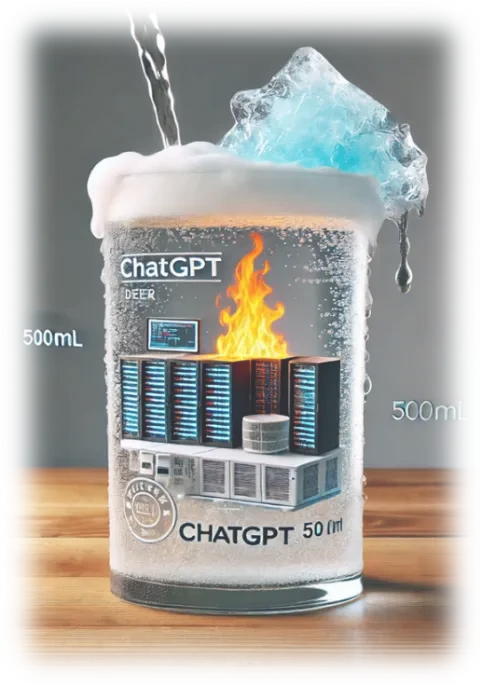
ChatGPT consumes an average of 500 milliliters of cooling water per question answered (2022 Microsoft Sustainability Report)
Alone, data centers consume 1% of global electricity annually. This may seem small, but it equals Japan's total annual power usage. By 2034, this will match India's annual consumption.
This power consumption has turned data centers into true "energy vampires."
Taking ChatGPT as an example, it has evolved to its fifth generation, while the third generation is already obsolete. However, training a third-generation large model consumes as much electricity as a household uses in 120 years. Models with even more powerful capabilities coming later will require even more energy.
Next, running the trained AI model to answer questions and perform calculations also consumes resources. If you ask ChatGPT 50 questions, it will use between 350 and 500 milliliters of water for cooling.
Malaysia and Indonesia leveraging resource advantages to catch up with AI development
Initially, many countries failed to recognize this issue. For example, in 2019, Singapore aggressively developed its digital technology sector, attracting companies like TikTok, Huawei, and Alibaba to establish cloud computing and data centers locally. However, it was later discovered that these facilities consumed vast amounts of water and electricity, even impacting essential public utilities. As a result, Singapore had to pause this industry's expansion.
However, this decision has fueled the growth of data centers in Malaysia and Indonesia.
For example, Malaysia's abundant resources have attracted a surge of global data centers. On multiple visits to local law firms with "Mr. Law," we observed a sharp increase in data center-related workloads, which has pushed their legal service capacity to near saturation.
After recognizing the issue, Singapore adjusted its policy in 2023 to support the development of "green data centers," hoping to reverse the trend. However, due to the high entry barriers for green data centers, only world-class enterprises can meet the requirements; many other companies continue to choose Malaysia and Indonesia instead.
Resource competition has thus become a major global concern.
For instance, former U.S. President Trump repeatedly expressed intentions to annex Canada and Greenland, primarily due to the region's abundant hydroelectric resources. the lenses of technology See, the logic behind this is now clear: resources will shape the future landscape of tech competition.
Section 4:the lenses of technology The New AI Landscape
We hereby the lenses of technology Let's reorganize the new AI technology landscape once again. the lenses of technology Does it offer you a fresh perspective?
We often see that big data will become a critical resource for the future, much like oil. AI's core lies in high-speed computing and organizing big data to create value. Therefore, the importance of AI is clear.
However,the lenses of technology Let's go further: AI does not exist in isolation. Its computing power relies on GPU chips; while chip performance and quantity are crucial, massive resource support is also required, especially for water and electricity. The country with stronger hydropower infrastructure is more likely to dominate AI and big data applications, potentially even achieving national hegemony.
Deeper still, we see that this demand creates opportunities for rapid data center growth—but these opportunities come with geographic constraints that shape global expansion strategies.
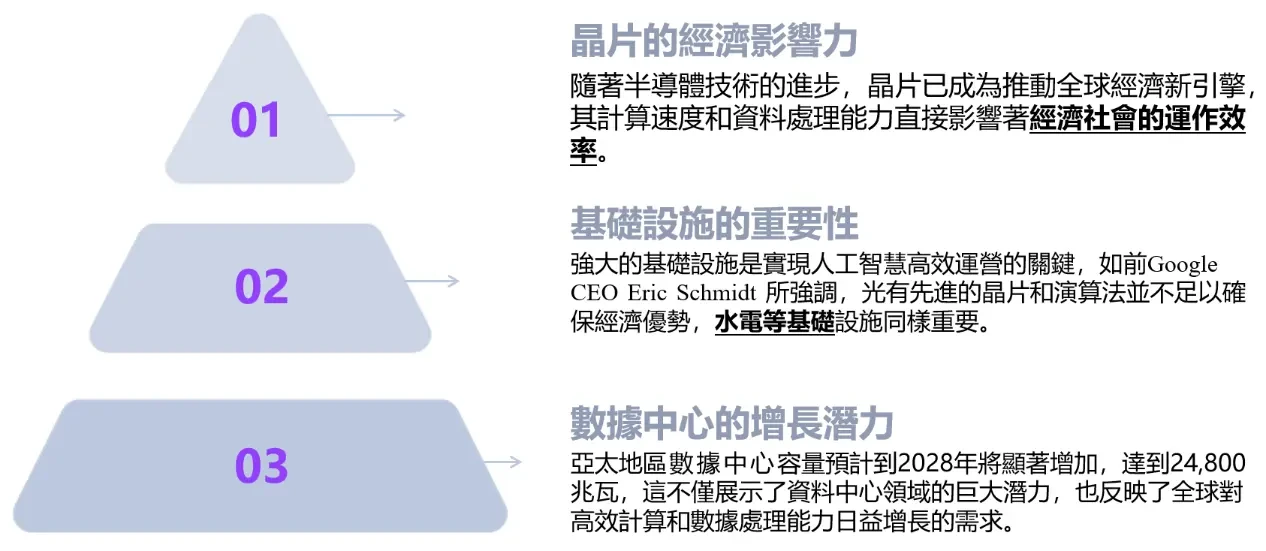
To summarize the logic of AI development we've explored, four sentences are needed to fully capture it:
Control of oil once shaped the global economy; today, control of data holds equal power.
To compete for data dominance, sufficient power is the basic entry ticket.
Data center site selection must consider the policy environment and resource conditions to determine overseas expansion strategy.
Proximity to the chip supply chain puts you at the industry's forefront.
Therefore the lenses of technology This gives us a comprehensive view: AI competition involves not only technology, but also resources, policies, and global positioning.
And if we put on the lenses of technology, Observing Vietnam and Malaysia reveals distinct industrial landscapes.
the lenses of technology Down, development opportunities for going overseas to Malaysia
Malaysia established its semiconductor industry in the 1970s, predating TSMC's manufacturing facilities. For years, Malaysia has focused on packaging and testing—the midstream stage of chip production that involves dicing wafers into individual chips, encapsulating them, and performing quality tests—rather than wafer fabrication, which is TSMC's core business.
However, the U.S. has begun strictly requiring TSMC to comply with U.S. technology export controls. Additionally, TSMC's location in Hsinchu faces escalating geopolitical risks amid the trade war. These combined factors have created new opportunities for Malaysia. Malaysia aims to leverage this moment to expand its semiconductor industry and plans to secure a prominent position in the global chip market by 2028.
As a "third-party nation" in great power competition, Malaysia is favored for its openness and flexibility. For instance, internet users in Malaysia can access global websites and widely leverage blockchain technology, creating favorable conditions for innovation-driven development.
Data centers and computing facilities in Malaysia, located away from the control of gambling nations, maintain a relatively neutral stance. With abundant resources and low costs, they offer an excellent alternative to Singapore.
Due to this advantage, many companies chose to route through Malaysia or Singapore during Trump's first term to help Chinese firms access controlled chip technology.
While this issue has drawn U.S. attention and Malaysian officials have specifically warned companies investing in Malaysia, the country's semiconductor industry still has significant room for growth. It could serve as a bridge for companies from Taiwan, mainland China, and other regions to collaborate via third countries.
However, the feasibility of such cooperation necessarily requires the involvement of legal and compliance personnel. Given the context of great power competition, these collaborations will be subject to rigorous scrutiny. As a third-party platform, Malaysia has the potential to integrate regional advancements in semiconductors, AI, big data, and blockchain, making its future development worth watching.
the lenses of technology Join Vietnam's "Leapfrog" initiative
Like other AI and semiconductor sectors, Vietnam aims to capture opportunities in this field. However, it faces infrastructure challenges such as water shortages, power deficits, and a lack of sufficient engineers—particularly professionals with five or more years of experience. To address these gaps, Vietnam must rely on external support and increase investment.
Nevertheless, we must not underestimate Vietnam's potential. We propose a "leapfrog" concept.
Just as AI is gradually transforming our lives, many businesses still haven't adopted AI tools because the gap between traditional workflows and experience remains too wide.
A similar situation is unfolding in blockchain technology. Bitcoin rose from 1 thousand to 10 thousand U.S. dollars in a relatively short time. Setting aside legality, most people still struggle to understand the logic behind Bitcoin: If it's speculation, what underpins that speculation? Why is the U.S. considering it as a strategic reserve, and why have some nations designated it as their national currency?
For one generation, it's hard to grasp because this new asset value logic upends the thinking patterns we're used to.
This is not a problem but a common phenomenon, highlighting significant differences in how age groups adapt to new technologies. Younger generations demonstrate greater adaptability in embracing blockchain finance, quantum computing, and AI integration into the workplace.
Although Vietnam lacks an industrial base, its demographic structure offers significant advantages. We will explore this in greater depth in a dedicated section below.
Section 5:the lenses of technology summary
Every major shift in human civilization has been driven by profound technological forces: the printing press spread knowledge, electricity and the internal combustion engine sparked the Industrial Revolution, and the internet has connected the world like never before.
Today, we stand at a pivotal moment in the era of AI and big data.
As technology reshapes global industrial landscapes and offshore strategies, nations are crafting distinct innovation roadmaps based on their unique priorities. The U.S. is actively loosening regulations in AI and blockchain to attract global talent and capital, while China is forging a unique technical ecosystem path driven by national security and policy considerations. Much like the incompatibility of different railway gauges, these divergent approaches create compatibility challenges, prompting many enterprises to establish data centers or adopt strategic workarounds in locations such as Singapore and Malaysia.
From "0 to 1" innovation to "2 to N" scaling, technology repeatedly evolves across diverse environments, yet resource endowments are often overlooked. The AI and semiconductor race demands not only advanced chips and big data but also massive water and power resources. These factors directly determine the location of data centers and computing facilities and shape corporate expansion strategies abroad.
Put on the lenses of technology Countries like Malaysia and Indonesia, with abundant hydropower resources, are gaining greater influence in the global tech landscape; Vietnam, meanwhile, is seeking breakthroughs through its young population and potential for leapfrog growth.
Therefore, only by wearingthe lenses of technologyOnly then can these shifts be clearly understood: focusing on technological frontiers such as chip design and AI algorithms, while also scrutinizing water and energy resources and policy boundaries.
We also see how technological advancement reshapes global industry layouts and influences decisions to expand overseas. As history repeatedly demonstrates, every major historical shift has been driven by technology, pointing toward even broader opportunities for global expansion in the future.
Extended Content
Put on the lenses of technology, Seize the opportunity:
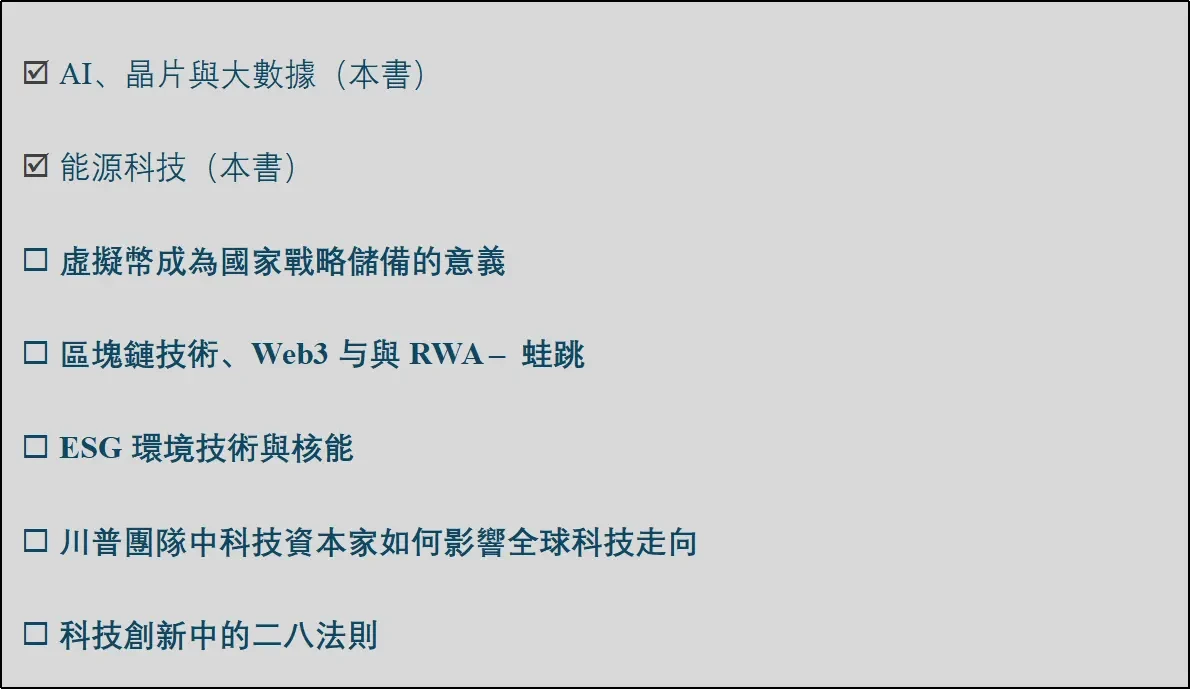
This book focuses on how to wear the lenses of technology, In the fourth wave of global expansion, how can you position yourself at the forefront of AI chips, big data, and energy technology?
However,the lenses of technology Its role extends further. It also helps us gain insights into cross-border expansion in areas such as cryptocurrency, blockchain technology, environmental tech, and tech policy. We will explore these use cases in greater detail in future updates. Interested readers can follow this framework to start their own exploration or engage with us for discussion.
For topics touched upon but not deeply explored in this book, we first provide a concise overview to demonstrate the lenses of technology unique value.
The Significance of Cryptocurrency as a National Strategic Reserve
Cryptocurrency is a sensitive topic in China. Yet it has become increasingly important, as the U.S. may designate it as a national strategic reserve. Have you considered what this means and how it could affect you? You might still be unclear on the details.
In the financial industry, there's a saying: If you don't know who your prey is, you might be the prey; if you don't understand who will be harmed, you could be the victim. Therefore, we need to deeply understand this issue.
What exactly is the strategic reserve storing? Although China has banned Bitcoin, it is actually the world's second-largest holder of Bitcoin. This may come as a surprise to many. These holdings were not acquired through normal commercial activities but rather seized from illegal gains in the early days, and they were not accumulated for strategic reserve purposes.
The U.S. faces a similar situation. The FBI and CIA seized large amounts of Bitcoin during law enforcement operations, primarily from dark web transactions where cryptocurrencies are widely used for illicit activities. Once detected, these assets are confiscated.
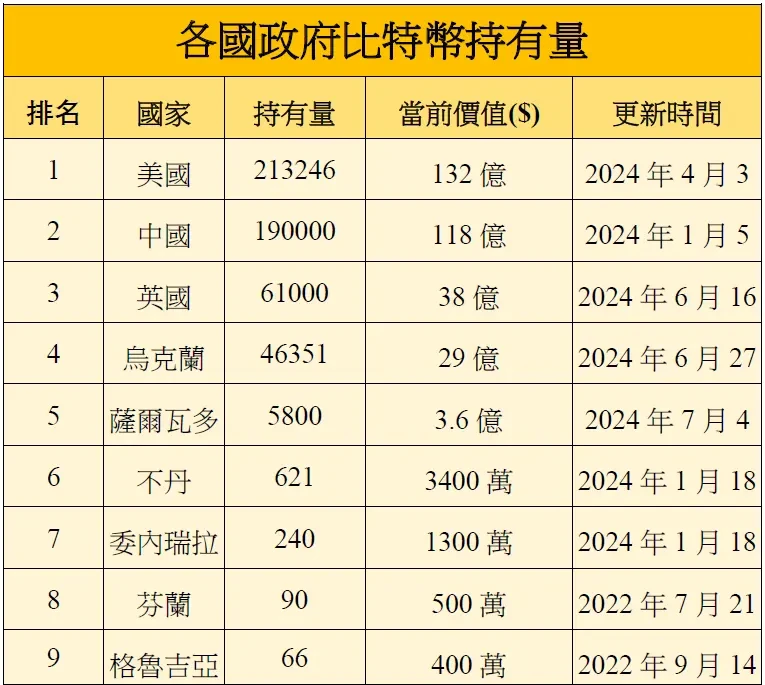
However, some countries have even adopted Bitcoin as legal tender, such as El Salvador. Russia, due to foreign exchange restrictions, has explicitly permitted the use of Bitcoin for transactions to purchase essential goods.
At the same time, China has repeatedly reaffirmed that Bitcoin is illegal within its borders. In contrast, the U.S. plans to establish policy treating Bitcoin as a potential strategic reserve. This stark divergence highlights an unprecedented great-power contest—a complex dynamic worth examining in detail.
To understand how Bitcoin reached $10K, we must first ask: is this purely speculation? Turning to the U.S. dollar, why does it hold value? Over human history, more than 2000 currencies have vanished. Will the dollar face the same fate in the future?
Gold is the only currency that has never disappeared. Throughout history, regardless of how human societies have changed, gold has maintained its value. This is a key entry point for exploring dollar hegemony and the Bitcoin phenomenon.
We don't need to dive deep into Bitcoin's technical logic; instead, we should re-examine this issue from the perspective of great power competition: As the world's strongest currency, why is the US pushing Bitcoin? What strategies might be behind it? How will it affect us? And what different opportunities do Southeast Asian countries' varying policies on these tech sectors offer for businesses and individuals looking to expand overseas?
Put on the lenses of technology, We will be able to gain insights into these issues.
Blockchain Technology, Web3, and RWA – Flare
Our team is dedicated to innovating blockchain business models, particularly new approaches that integrate Real World Assets (RWAs) with Intellectual Property (IP). While this concept may be unfamiliar to many, it represents the future trend of the next-generation economy.
The rapid advancement in this tech field is particularly worth exploring as a key topic, for two main reasons:
First, as noted above, the U.S. and China have adopted divergent strategies in technology pathways and policies, leading to a growing split in their development trajectories for the digital economy, blockchain, and AI. China has built an independent blockchain infrastructure incompatible with open global public chains and strictly regulates crypto assets like Bitcoin. In contrast, the U.S. has taken the opposite approach: it is incorporating Bitcoin into its strategic reserves and actively advancing the Web3 revolution to maintain leadership in decentralized technologies.
Furthermore, China's relatively closed internet ecosystem prevents direct access to overseas technologies like Google and OpenAI, further deepening the fragmentation of the global digital landscape.
Therefore, companies going global must navigate a fundamentally different ecosystem. While this offers greater market and policy opportunities, it also brings challenges from varying technical standards and compliance requirements. In an era where "data is the new oil," adapting to these conditions and making optimal decisions has become an unavoidable imperative for businesses expanding internationally.
Second, the impact of technological development is often non-linear. It may leap forward unexpectedly and explode at a specific point in time.
This non-linear growth is typically driven by technology accumulation, industry synergy, and market demand. For example, artificial intelligence rapidly penetrated various sectors following breakthroughs in deep learning, while advances in new energy battery technology sparked explosive growth in the electric vehicle industry.
Different countries' technology development paths may also experience phased leadership or lag due to this characteristic, creating opportunities for leapfrog advancement.
For example, in the mobile communications sector, the U.S. rollout has been slower than China's. While multiple factors contribute to this, a key reason is that the U.S. historically had higher wired broadband penetration and more mature network infrastructure, whereas China still faces lower coverage in many regions.
This initial lag later became an advantage.
Entering the mobile communications era, the U.S. faced challenges phasing out and replacing legacy equipment, restructuring organizational management, and renegotiating contracts with major carriers, which slowed progress.
In contrast, China, unburdened by legacy infrastructure, bypassed wired networks and rapidly deployed mobile base stations to achieve wide coverage, accelerating the advancement of mobile communication technology.
This leads to the "leapfrogging" concept we'll discuss next.
In the future, where will your children's economic output and growth come from? They are likely to "leapfrog" past the development stages of previous eras and enter a completely new economic era.
According to McKinsey research, by 2030—in less than 10 years—the bonds, mutual funds, and exchange-traded notes we know will be tokenized. This tokenization via RWA (Real World Assets) will fundamentally transform the existing financial system.
So, what is RWA? It's actually simple. In short, RWA refers to tokenized digital records of real-world assets. While it fundamentally serves as a way to record assets, it has the power to reshape the entire financial system. Each iteration brings irreversible systemic transformation, and RWA is one of the key technologies driving this change.
According to 2024 statistics, approximately 40% of Vietnam's population is under 30 years old. These young people are true "digital natives," having grown up alongside AI, blockchain, and digital technologies. For instance, they graduate from university with proficiency in using the internet, whereas older generations may find it challenging. Similarly, learning new applications of AI, blockchain, or quantum computing is not easy for them.
In Vietnam, these digital natives bypassed the familiar internet ecosystem entirely. They went straight to learning how to converse with AI or use blockchain finance—relying on no traditional tools as they stepped directly into a world of new technology.
Therefore, even without an industrial foundation, development opportunities are not absent. Instead, it becomes easier to shed outdated mindsets, bypass the development path of previous generations, and forge a new route—this is what we call "leapfrogging." How Vietnam's younger generation will drive national progress in the future is worth watching closely.
But if you still haven't realized how blockchain and RWA will reshape the future of the global economy, it's time to put on your thinking cap. the lenses of technology, Let's explore the trends and developments in this area together.
ESG Environmental Technology and Nuclear Power
ESG (Environmental, Social, and Governance) environmental technology is a critical topic. Los Angeles serves as a prime example: the city faces frequent wildfires that often intensify despite firefighting efforts.
These fires stem not only from natural disasters but also from human factors. They also involve ESG technology policies, which play a critical role and warrant deeper exploration.
ESG technology issues are also a key battleground for geopolitical tensions and great power competition.
On a grand scale, it involves massive capital, technology, and the future of industrial development—potentially determining humanity's shared destiny in 50 years. On a personal or corporate level, the commercial opportunities it creates are no less significant than those from AI and semiconductors.
As analyzed above, ESG energy issues are directly tied to AI computing power. In the race for economic dominance between digital hegemony and environmental protection, the global balance has quietly tipped in favor of the former. Nuclear power, increasingly seen as a key solution, is likely to trigger social and safety concerns, as well as political controversy.
In 2024, Google announced plans to acquire small modular reactors (SMRs) to meet the long-term power needs of its data centers. Later that year, in 9, Microsoft planned to restart the Three Mile Island nuclear plant to provide stable power for its data centers. Tech giants are actively leveraging advanced nuclear energy technologies to ensure sustainable and efficient power supply for AI-driven infrastructure, while reducing carbon emissions and mitigating risks associated with power instability.
At the national level, countries that once firmly opposed nuclear energy are now gradually softening their stance, seeking technological solutions such as safer fusion technology to persuade voters to adjust energy policies. This represents an innovation from 0 to 1. Is it reliable? If realized, how would it reshape the underlying logic of the global economy?
Although Vietnam continues to aggressively develop its industrial base, as a signatory to international agreements such as the Paris Agreement, it has committed to achieving net-zero carbon emissions by 2050 and established the 2021-2030 National Green Growth Strategy. Consequently, there is growing emphasis on ESG compliance. According to feedback from local manufacturers, the strictness and pace of environmental enforcement in Vietnam are at least on par with those in China.
As mentioned above, Vietnam's insufficient energy supply has become a ceiling for industrial development. In 2009, Vietnam approved plans for two nuclear power plants; however, the project was suspended due to concerns including safety. By 2024, Vietnam approved restarting the nuclear power project, emphasizing that it is a national priority requiring comprehensive resource allocation.
ESG issues are equally critical in Malaysia. As noted earlier, Singapore paused applications for data centers and cloud computing facilities around 2021 due to stringent ESG requirements, which redirected projects to Malaysia and Indonesia, driving growth in both countries.
However, in early 2025, feedback from the local industry indicated that data centers and cloud computing facilities in Johor were already saturated. Moving forward, how the Malaysian government balances ESG regulations with economic growth will be a critical issue.
Returning to the quote at the beginning of this chapter, technological innovation from 0 to 1 is what will be needed to resolve this dilemma.
How tech capitalists in Trump's team are influencing the global direction of technology
At the lenses of technology From this perspective, humans are also a key factor.
Geopolitical competition between major powers profoundly shapes our decisions to expand overseas. In this contest, the United States is a primary player, and its current leadership team consists largely of tech capitalists, each wearing... the lenses of technology How do they view the world? What is their mindset?
Taking Peter Thiel as an example, he argues that going from 0 to 1 is the hardest, while moving from 1 to N is relatively easier. If everyone only focuses on development from 1 to N, it could lead to situations like "involution" in China. He has consistently encouraged innovation and driven this philosophy through action. Early in his career, he invested in Facebook with significant returns; later, he co-founded PayPal with Elon Musk, pioneering the online payment system.
During Trump's term, Peter Thiel and his tech circle friends—known as the PayPal Mafia—played a pivotal role. He recommended a cohort of active Silicon Valley tech and investment leaders to join the government, including JD Vance, who became Vice President under Trump, along with more than a dozen experts in cryptocurrency and related technologies. These individuals drove innovation and commercial expansion, gaining extensive hands-on experience from 0 through 1, and from 1 to N. They will leverage this expertise to shape America's technology strategy.
The other is Elon Musk, known as the "Shadow President." With extensive influence in technology, business, and public opinion, he leads companies like Tesla and SpaceX. Beyond driving progress in energy policy, space exploration, and artificial intelligence, he actively engages in public discourse through social media, shaping global market trends and policy debates.
Their focus differs from ours, but that's precisely why we must understand how they view the world and approach technological innovation. Put on the lenses of technology, only then can you understand their thoughts.
The 80/20 Rule in Technological Innovation
The Pareto Principle, a classic economic concept, manifests uniquely in the realm of technological innovation. Renowned Taiwanese scholar Mr. Paul S.P. Hsu The proposed "Innovation 20-80 Law" states that technological breakthroughs alone account for only 20% of value, while business model innovation built upon technology creates 80% of the value potential.
Using the AI technologies analyzed in this book as examples, focusing solely on the development of algorithmic models captures only 20% of the value. For instance, at the time of this book's publication, the discussion around DeepSeek's cost-effectiveness sparked a global frenzy. Experts, politicians, business leaders, and ordinary people across all sectors rushed to voice their opinions. In reality, much of this commentary was merely echoing others.
When we wear the lenses of technology, You can clearly see the complete ecosystem formed by AI and its interconnected domains such as big data, semiconductors, and energy. This is where the core of creating 80% value lies. Simply chasing technology trends without systemic thinking will ultimately prevent you from capturing true value.
Real-world developments confirm this pattern: Uber integrated mature technologies like GPS and mobile payments to build a ride-sharing platform that disrupted the traditional taxi industry. Although these technological components had existed for years, their innovative reorganization through a new business model unlocked exponential value. Airbnb demonstrates the same principle: combining location services with credit-based rating systems gave rise to the world's largest accommodation-sharing platform, fueling the explosive growth of the sharing economy in the Web 2 era.
The deeper insight of this principle is breaking the "technology-centric" mindset. People often get caught up in the novelty of technology, overlooking that innovation's true essence lies in solving real-world needs.
Therefore, we must consciously adopt a broader industry perspective to effectively connect technological advancements with consumer pain points and business scenarios. This is the essence of DAI SHANG. the lenses of technology function.
Put on the lenses of technology, You can also delve into another issue: how intellectual property rights are flexibly leveraged, as they form the key support system for realizing 80% of the value.
Using Coca-Cola as an example, its century-long success stems not only from its secret formula (patents and trade secrets) but also from the precise integration of intellectual property with concentrated syrup production, bottling systems, and global marketing networks, creating a hard-to-replicate business ecosystem. This systematic IP management approach is the key to unlocking 80% value.
Approved the lenses of technology, We now clearly recognize: technological innovation is not a solo performance in the lab, but a symphony requiring business acumen, ecosystem thinking, and strategic system design. Only by deeply understanding this fundamental principle can we create real value in the digital economy era.
- Book
- The Chinese Diaspora
- Author
- Dr. Jili Chung
- Section
- Subject
- Words
- Appointment10,769Character
- Reading
- Appointment27minutes